

One of the most beautiful ideas in Tai Chi is also one of the easiest to misunderstand:
Be soft, but not empty.
When people first hear the word soft in Tai Chi, they may imagine becoming completely loose, floppy, or passive. The shoulders drop, the arms become lifeless, and the posture loses its shape.
But that is not the softness Tai Chi asks of us.
Tai Chi softness has presence.
It has structure. It has awareness. It is relaxed, yet alive.
Imagine holding a small bird gently in your hands. If you grip too tightly, you hurt it. If your hands are completely limp, the bird may escape. Your hands must be soft enough to receive, yet present enough to support.
That is close to the feeling we seek.
Soft, but not empty.
The Willow and the Wind
I often think of a willow tree.
When strong wind arrives, the willow does not stand rigidly and fight it. Its branches bend and move with the wind.
Yet the tree is not weak.
Its roots remain connected to the earth. Its trunk keeps its integrity. Its branches yield, but they do not become lifeless.
When the wind passes, the willow returns.
A stiff branch may resist until it breaks.
A dead branch simply hangs.
But a living branch can yield, adapt, and return.
This is a wonderful image for Tai Chi.
Soft like a living branch — not stiff, not limp.
This quality can be felt particularly clearly in Roll Back and Press.
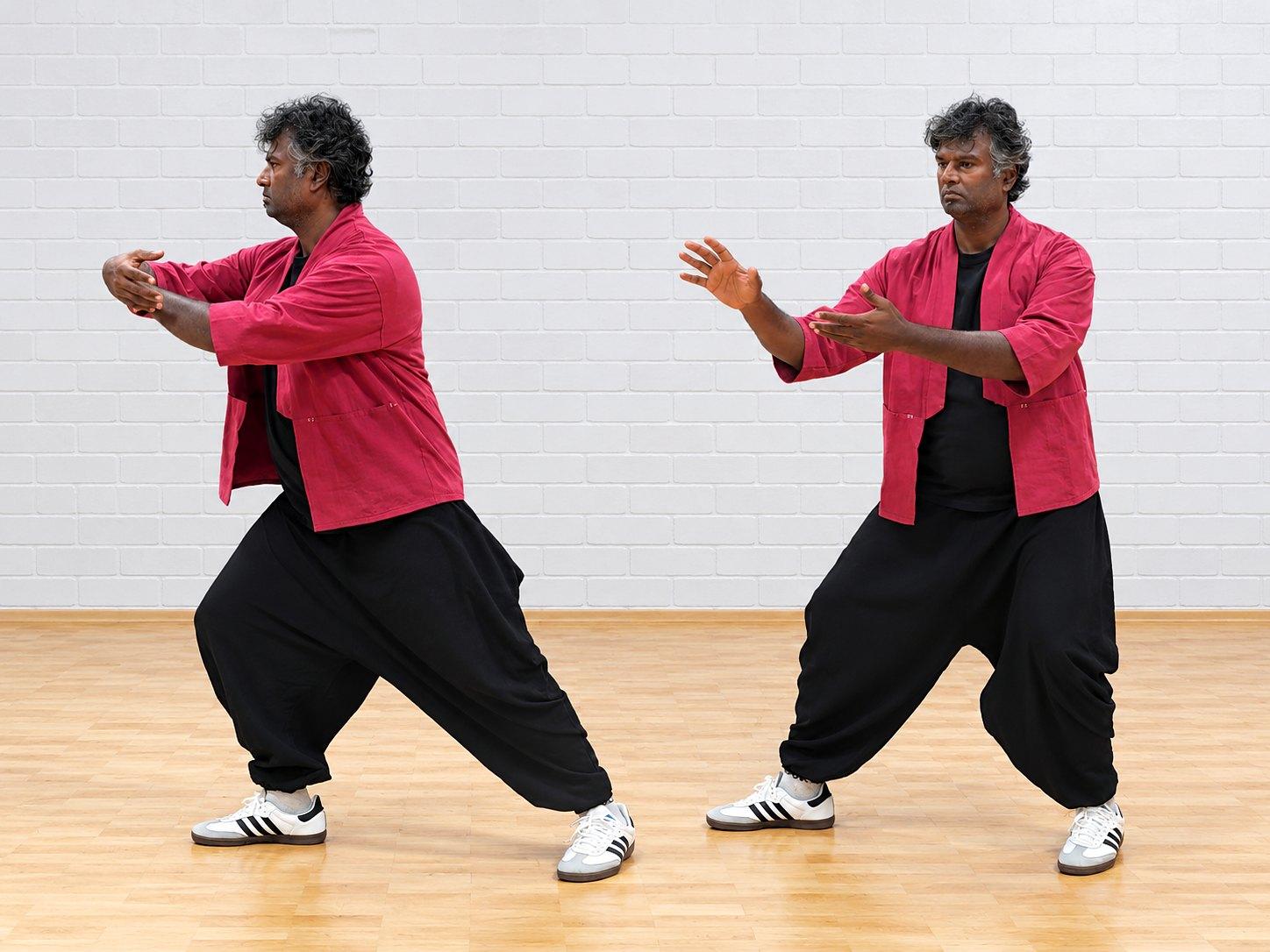
In Roll Back, we receive.
We do not meet incoming force with unnecessary force of our own. We soften, turn, listen and redirect.
But we do not collapse.
The feet remain rooted.
The centre remains present.
The arms remain connected to the body.
The mind continues to follow the movement.
Then comes Press.
The energy that was received is expressed again — not through muscular aggression, but through connection.
Roll Back teaches: Receive without collapsing.
Press teaches: Express without forcing.
Together they give us a living example of Soft, Not Empty.
Softness Requires Attention
There is a beautiful connection here with creativity.
Creativity is not only painting, music or writing.
At its deepest level, creativity begins with attention.
We notice.
We feel.
We respond.
A painter becomes sensitive to colour.
A musician becomes sensitive to sound.
A Tai Chi practitioner becomes sensitive to movement.
We begin noticing small things.
- How much tension am I carrying in my shoulders?
- Am I rushing into the next posture?
- Did I actually finish transferring my weight?
- Am I forcing the movement because I want to “get it right”?
- Can I soften a little more without losing my structure?
This sensitivity is part of the practice.
The more carefully we pay attention, the more refined the movement becomes.
Not because we are adding more effort.
Often because we are removing it.
Softness in Everyday Life
Perhaps the most interesting part of this principle is that it does not have to remain inside the Tai Chi room.
Life constantly gives us moments of Roll Back and Press.
Someone disagrees with us.
Something does not go according to plan.
A difficult conversation appears.
Our first reaction may be to stiffen and resist.
Tai Chi offers another possibility.
Receive first.
Listen.
Do not immediately push back.
Do not collapse either.
Stay centred.
Understand what is coming toward you.
Then respond.
This does not mean becoming passive.
Softness is not surrender.
It simply means we do not waste energy fighting everything that touches us.
Sometimes strength is knowing when to yield.
Sometimes strength is knowing when to return.
Yin and Yang — Softness Needs Firmness
The idea of Soft, Not Empty is also deeply connected to Yin and Yang.
In Tai Chi, Yin and Yang are not fixed opposites. They are constantly changing into one another.
Softness contains firmness.
Firmness contains softness.
Receiving prepares the way for expressing.
Yielding can create the conditions for returning.
This is what we feel in Roll Back and Press.
Roll Back is more Yin: receiving, yielding, absorbing.
Press is more Yang: expressing, returning, advancing.
But neither is completely one or the other.
There is still structure inside the softness of Roll Back.
There is still relaxation inside the firmness of Press.
This is the balance we are looking for.
Too much hardness becomes rigidity.
Too much looseness becomes collapse.
Yin without Yang can become empty.
Yang without Yin can become forceful.
Somewhere between them is a living quality:
Relaxed, but connected.
Yielding, but supported.
Quiet, but attentive.
Soft, but full.
This is not a static balance.
It is a changing balance.
A conversation between Yin and Yang.
A constant adjustment between receiving and expressing, opening and closing, empty and full.
That is what gives Tai Chi its life.
A Small Reminder for Practice
The next time you practise Roll Back, imagine the willow moving with the wind.
Do not run away from the incoming movement.
Do not fight it.
Receive it.
Stay rooted.
Stay connected.
Then, as you move into Press, allow the whole body to return together.
Do not push harder.
Connect better.
And perhaps remind yourself:
Yield without collapsing.
Connect without stiffening.
Express without force.
That is the quiet strength of Tai Chi.
That is Soft, Not Empty.